Investment Magazine / Special
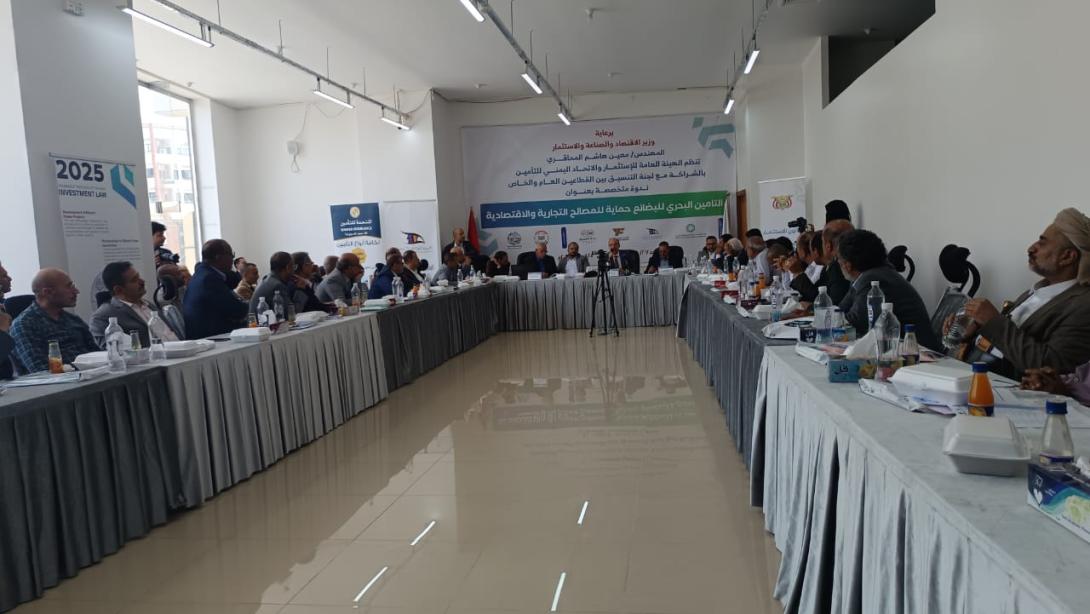
GIA and the Yemeni Insurance Federation, in partnership with the Public-Private Coordination Committee, organized a specialized seminar entitled, "Marine Cargo Insurance. Protection of commercial and economic interests", with the wide participation of the private sector, insurance companies, experts and specialists.
The seminar discussed the importance of localizing marine insurance as a strategic step to protect the national economy, prevent the leakage of hard currency, and enhance confidence in Yemeni insurance companies, amidst a wide attendance of representatives of government agencies, chambers of commerce, regulatory bodies, and the private sector.
In his opening speech, H.E. Minister of Economy, Industry and Investment Eng. Moeen Hashim Al-Mahakri emphasized that localized marine insurance is not a commercial option, but a national obligation and sovereign entitlement to protect the national economy and reduce dependence on foreign countries.
He emphasized the need for the concerned authorities to play their role in enforcing compliance with national insurance policies and activating coordination between regulatory, customs and port authorities.
For his part, Mohamed Ahmed Hussein, Head of the Promotion Sector at the General Authority for Investment, emphasized that maritime insurance is not only a tool to protect goods, but also a key pillar to enhance the confidence of local and international investors, pointing out that supporting national insurance companies will contribute to creating a stable trade environment.
Mohammed Mohammed Salah, Vice President of the General Federation of Yemeni Chambers of Commerce and Industry, pointed out that the private sector supports local insurance provided the quality of service, stressing that the private sector does not oppose the commitment to local insurance, but it needs efficient, professional and flexible insurance services.
Mohannad Al-Shami, head of the Public-Private Sector Coordination Committee, explained that the successful implementation of local insurance for imported goods requires real coordination between the concerned authorities, stressing that the law is not implemented in isolation, but within the framework of institutional integration.
Abdulkarim al-Mansour, an advisor to the Customs Authority, stressed that customs plays a pivotal role in implementing laws related to maritime insurance, stressing the need to link customs clearance to the presence of a local insurance policy issued by a licensed company inside Yemen.
"We cannot continue with a laxity that costs the economy millions of dollars annually. Linking between customs and insurance companies is essential to ensure enforcement."
The Secretary General of the Yemeni Insurance Federation, Salah Abdul Habib Al Absi, pointed out that marine insurance for goods is not just a legal clause in a written text, but a security contract between the country and its future. When we insure imported goods through local insurance companies, we not only protect the goods, but also protect the sovereignty of our economic decision and put an impenetrable dam against risks that threaten market stability and hinder the path of development.
The seminar reviewed an explanatory video presented by the Deputy General Manager of Trust Yemen Insurance and Reinsurance Company, Fahim Saeed Al-Salawi, in which he explained that marine cargo insurance represents a real protection of Yemen's commercial and economic interests.
At the end of its work, the seminar recommended obliging importers with national insurance policies, strengthening the role of regulatory authorities and activating mechanisms to implement laws, supporting local insurance companies to develop their services and increase their competitiveness, and activating the electronic link between the relevant authorities to ensure the accuracy and speed of procedures.
The participants emphasized that marine insurance is an economic tool with a strategic dimension, and that the success of this trend depends on the seriousness of implementation and institutional cooperation from various parties.
Comments