Investment Magazine – Exclusive
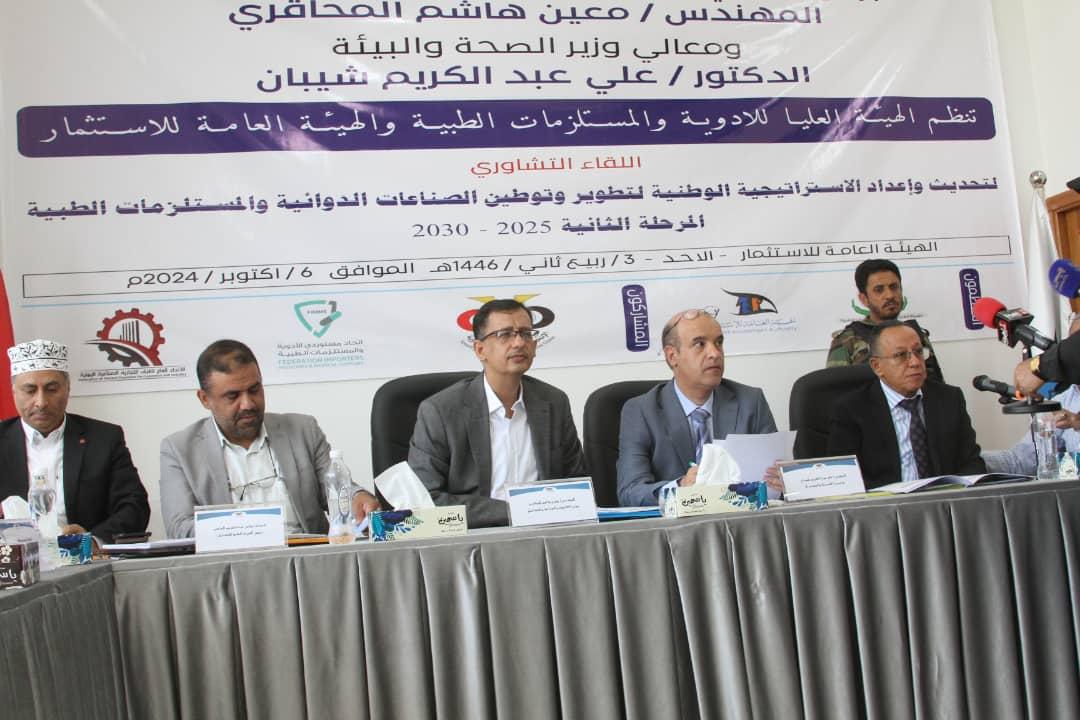
On Sunday, October 6, 2024, the General Investment Authority and the Supreme Authority for Medicines organized a consultative meeting aimed at updating and preparing the national strategy for developing and localizing the pharmaceutical and medical supplies industries for its second phase (2025-2030). The event was held under the patronage of His Excellency the Minister of Economy, Industry, and Investment, Engineer Maeen Al-Mahaqri, and His Excellency the Minister of Health and Environment, Dr. Ali Abdul Karim Shaiban.
During the opening speech, the Minister of Economy, Industry, and Investment emphasized the government's commitment to fostering partnerships with the private sector to implement the national strategy for developing and localizing the pharmaceutical and medical supplies industries. He stressed that this strategy is a national priority that cannot be abandoned.
The minister also announced that 15 strategies would be launched in the coming period to gradually localize national industries and replace imports, reflecting the government’s interest in creating job opportunities, combating unemployment, and ensuring social stability and prosperity.
He explained that the pharmaceutical development strategy aims to achieve 50% local production, with a focus on life-saving medicines and antibiotics, supported by the construction of 19 new pharmaceutical factories.
The minister reaffirmed the government's commitment to resolving all issues facing investors in the pharmaceutical sector through innovative solutions and encouraged manufacturers to increase production to meet market demand and seize export opportunities, especially given Yemen's advantageous geographical location near international markets.
Engineer Al-Mahaqri called on national investors to seize the available opportunities in the local pharmaceutical industry, highlighting the ministry’s dedication to overcoming the challenges facing both the public and private sectors in this field.
He further noted that achieving only 28% of the objectives set in the first phase of the strategy was insufficient and that the second phase should aim to reach 75%. The minister stressed the importance of private sector collaboration with the public sector to implement the strategy’s programs and update the economic reality of the country.
Meanwhile, the Minister of Health and Environment pointed out that investment opportunities in Yemen’s pharmaceutical manufacturing sector are among the most promising due to their significant economic potential and the support provided by the government. He confirmed that the state would offer substantial incentives to promote investment in this vital sector.
He also emphasized the need to align training and capacity-building initiatives with the available opportunities in pharmaceutical production and urged both producers and importers to focus on this in the coming months.
The minister highlighted that the national strategy for localizing the pharmaceutical industry has already achieved promising results, with ambitions for further success, especially with continuous development and cooperation from all partners.
In his speech, Mr. Yasser Abdul Karim Al-Mansour, Chairman of the General Investment Authority, expressed the authority’s commitment to facilitating procedures and providing incentives, noting that the forthcoming amended investment law will include significant benefits to support local pharmaceutical manufacturing.
Dr. Ali Abbas, Chairman of the Supreme Authority for Medicines, pointed out that the partnership with the private sector is the cornerstone of the process of transforming and localizing the national pharmaceutical industry. The authority aims to guide and support pharmaceutical investments smoothly.
The meeting concluded with an overview of the progress in implementing the national strategy for developing the pharmaceutical sector, presented by Engineer Mohammed Al-Farazie, Head of Projects at the General Investment Authority. Additionally, speeches were delivered by representatives from the Yemeni Federation of Chambers of Commerce and Industry, the Union of Pharmaceutical Producers, and the Union of Pharmaceutical Importers, followed by discussions from the participants
Comments